
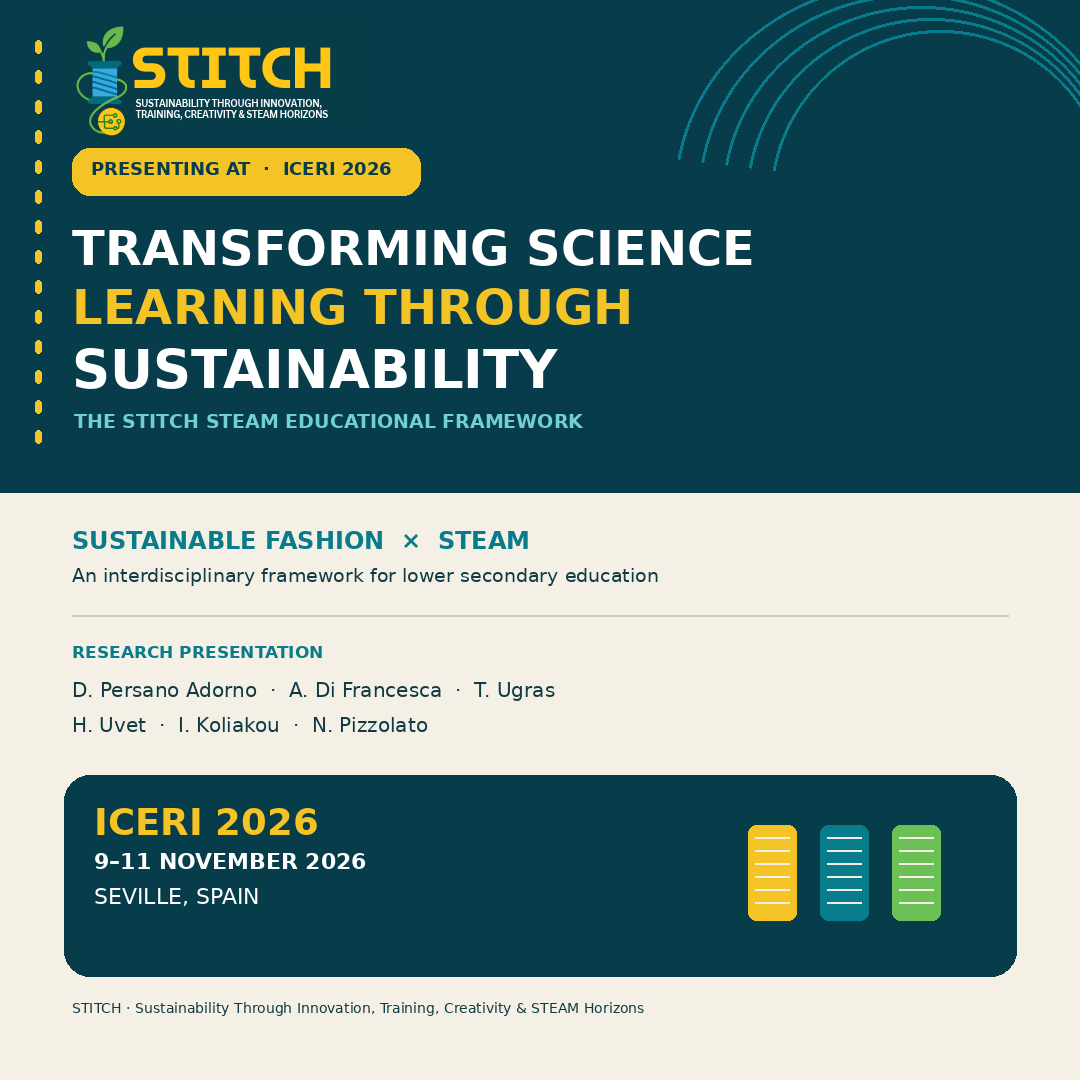
From 9 to 11 November 2026, Seville, Spain, will host ICERI2026, the 19th International Conference on Education, Research and Innovation. The conference brings together researchers, educators and professionals from different countries to share studies, experiences and innovative practices in education, technology and research. Its programme includes presentations, workshops and opportunities for discussion and exchange.
At ICERI2026, Professor D. Persano Adorno will present the paper “Transforming Science Learning through Sustainability: The STITCH STEAM Educational Framework” in person. The paper focuses on the educational model developed by the European project STITCH – Sustainability Through Innovation, Training, Creativity & STEAM Horizons.
Sustainable fashion as a starting point
STITCH addresses an important educational challenge: helping young people understand environmental issues and develop the skills to make informed choices. The project uses sustainable fashion as a familiar, practical context for connecting different subjects.
A garment, for example, can prompt students to investigate material properties, natural and synthetic fibres, production processes and resource use. It can also open up discussion about the environmental and social impact of the fashion supply chain, as well as opportunities for repair, reuse and more responsible consumption.
The STEAM approach brings together science, technology, engineering, the arts and mathematics. Students are encouraged to explore real-world challenges, gather information, compare alternatives and develop ideas for possible solutions. Creativity works alongside scientific reasoning: redesigning a garment means considering its materials, function, durability, comfort and potential for reuse.
A framework for teachers and students
The paper describes the principles and structure of the STITCH educational framework, designed for lower secondary education and students aged 11–14. It includes 14 learning modules and resources for teachers, with activities that combine inquiry-based learning, design, teamwork, digital tools and hands-on practice.
The aim is to move beyond simply learning about environmental problems and create opportunities for students to apply their knowledge. Through research and design activities, they can explore materials and production processes, analyse the consequences of different choices and communicate their ideas.
The paper also presents the evidence-gathering work carried out by the project partnership: a European collection of 35 educational best practices and 42 case studies. This analysis identified recurring approaches, including STEAM integration, hands-on learning, collaboration between schools and communities, and the 4Rs: Reduce, Reuse, Recycle and Recover.
From framework development to school piloting
Taking part in ICERI2026 will provide an opportunity to share the STITCH approach with the international education community and contribute to discussions about bringing sustainability into school learning. The paper presents the framework’s foundations and initial evidence. The next project phase will involve systematically piloting the resources in schools and collecting feedback to assess their usefulness and suitability for different educational settings.
For FICUS ETS, a partner in the project, this presentation highlights the work carried out with the European partnership and its commitment to educational approaches that connect sustainability, innovation and active participation.
📍 ICERI2026 – Seville, Spain
📅 9–11 November 2026
🎤 The paper will be presented in person by Professor D. Persano Adorno.
STITCH – Sustainability Through Innovation, Training, Creativity & STEAM Horizons is co-funded by the European Union’s Erasmus+ programme.
Discover ICERI2026 · Conference dates · Participation information
