
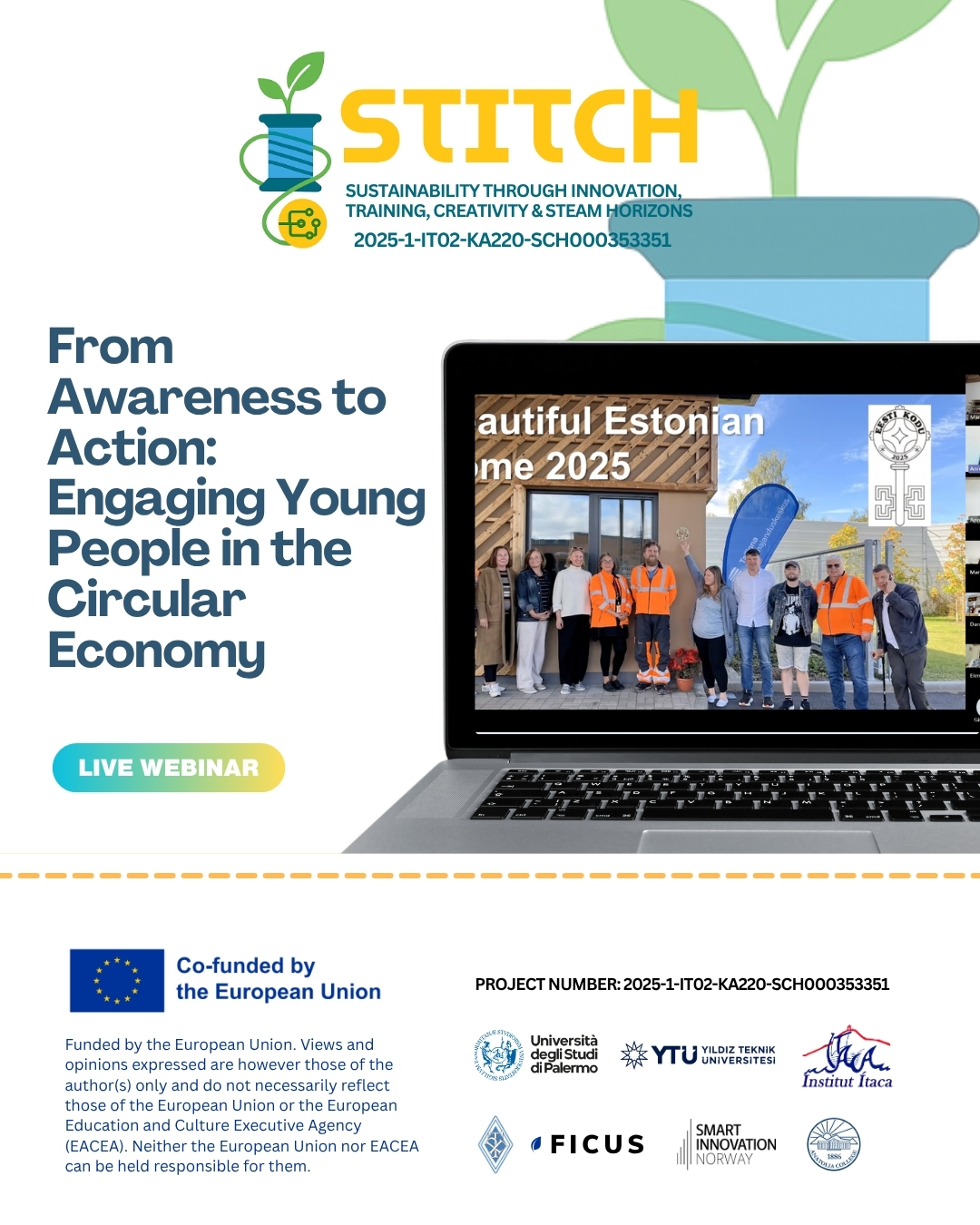
How can young people be supported in turning awareness of environmental issues into more responsible choices and actions? This question shaped the discussion at the sixth international STITCH webinar, “From Awareness to Action: Engaging Young People in the Circular Economy,” held on 6 October 2026.
The event was hosted by Tallinna Kesklinna Vene Gümnaasium, STITCH’s Estonian partner. FICUS ETS is also a project partner. STITCH is an Erasmus+ project co-funded by the European Union that promotes sustainability education through creativity, innovation and the STEAM approach (Project No. 2025-1-IT02-KA220-SCH-000353351).
The webinar was organised as part of Work Package 2 (WP2), which focuses on developing training resources and supporting teachers in bringing sustainable fashion and STEAM education into the classroom. Through its international webinar series, the project gives teachers and other participants opportunities to exchange ideas and learn from experiences across Europe. So far, the webinars have reached around 300 teachers and other participants, encouraging discussion on sustainability, the circular economy and innovative approaches to education.
Connecting sustainability with everyday life
The webinar opened with Anne-Liisa Antsma, a teacher at Tallinna Kesklinna Vene Gümnaasium, who introduced STITCH and its approach to sustainability education. A key aim is to connect environmental topics with students’ everyday experiences, helping them understand why these issues matter and how they relate to their own choices.
STITCH focuses particularly on the environmental impact of the fashion industry and works with teachers and students aged 11–14. The project uses the STEAM approach, which brings together Science, Technology, Engineering, Arts and Mathematics, to explore sustainability challenges through creative and practical learning.
Designing, making prototypes and giving garments a second life are examples of activities that can help students engage with real environmental questions. Through these experiences, sustainability becomes an opportunity to investigate, experiment and develop solutions, while also building creativity and critical thinking.
Making the circular economy meaningful for young people
The main session was led by Anneli Roodus, an environmental education specialist at the Tallinn Circular Economy Centre. She introduced key principles of the circular economy and explored ways to communicate them to young people in an accessible and engaging way.
Resources, materials and products are part of everyday life. Thinking about how they are used, how long they remain useful and what happens when they are no longer needed can help connect daily habits with wider environmental challenges. This reflection encourages young people to consider their consumption choices and the life cycle of the products around them.
Anneli also presented the work of the Tallinn Circular Economy Centre, including activities at the Lasnamäe Circular Economy Centre. Environmental education centres and programmes can offer practical learning experiences, helping students engage with topics that may otherwise seem complex or distant from their lives.
Moving from information to participation
Providing information is important, but environmental education can go further by giving young people opportunities to ask questions, compare perspectives and try out possible responses. Practical activities allow students to take part directly and recognise how their choices are connected to the use of resources.
The webinar highlighted several principles at the heart of STITCH’s approach: inquiry-based learning, hands-on experimentation, collaboration and reflection. When brought into the classroom, these principles can support active learning and help students build both knowledge and confidence in their ability to contribute.
A joint discussion between Anneli Roodus and Anne-Liisa Antsma also explored ways to bring circular economy principles into schools and youth work. Cooperation between schools, educators and environmental organisations can enrich learning by connecting classroom experience with specialist knowledge and practical activities. When young people are actively involved, they can see themselves as part of the process of change, rather than simply as recipients of information.
A European programme for sharing ideas and practice
The 6 October webinar was the sixth event in the international STITCH series. Previous sessions have explored different aspects of sustainability in fashion and education, from STEAM activities in the classroom to recycling, digital tools and turning waste into new products.
The series will conclude with a seventh webinar hosted by Institut Ítaca, STITCH’s Spanish partner, focusing on cooperation between schools and organisations. This continues the discussion opened by the webinar on the circular economy: meaningful learning experiences grow from dialogue between educators, organisations working in their communities and young people themselves.
For FICUS ETS, a STITCH partner, the webinar was another opportunity to contribute to a European exchange of tools and practices for bringing sustainability into schools. The message from the session was clear: environmental education should do more than explain challenges. It should help young people ask questions, make informed choices and recognise their role in building a more sustainable future.
Discover more about the project and its activities at euproject.eu/stitch.
